1. Your Data Engineers are Building Plumbing, Not Foundations
A modern data team should be focused on modeling data and generating insights. Instead, they are often consumed by the manual labor of data logistics.
- Proliferation of Non-Value-Added ETL: Teams spend cycles building and maintaining complex, point-to-point ETL pipelines solely to replicate data from source systems—like cloud data warehouses and lakehouses—into the legacy tool’s proprietary storage layer. This creates data redundancy, latency, and a maintenance nightmare.
- Fragmented Security and Governance: Your centralized identity provider (e.g., Azure AD, Okta) is the cornerstone of your security posture. A legacy BI tool that requires separate, manual user management creates a shadow identity system, leading to permission drift, compliance gaps, and significant overhead for IT.
The Technical Question to Ask: “What is the ratio of time spent on data movement and access management versus actual data modeling and analysis?” A disproportionate answer indicates your architecture is the primary constraint. A platform-native analytics layer eliminates this redundant plumbing by operating directly on your centralized data estate.
2. “Self-Service” is an Oxymoron, Breeding Anarchy
The promise of self-service BI was to decentralize insights and accelerate decision-making. However, legacy tools often feature unintuitive interfaces and poor performance, rendering this promise void. The result is not empowerment—it’s anarchy.
Business units, unable to get the answers they need, circumvent IT governance entirely. This manifests as:
- Proliferation of unauthorized analytics SaaS licenses.
- Critical business processes running on ungoverned, desktop-based visualization tools.
- The perennial “spreadsheet sprawl,” with critical data living in emailed, version-conflicted workbooks.
The architectural failure here is a lack of a unified, governed semantic layer. You lose a single source of truth, and your central IT team becomes a cleanup crew, reacting to chaos instead of enabling strategy.
3. The True TCO is Hidden in Overhead and Opportunity Cost
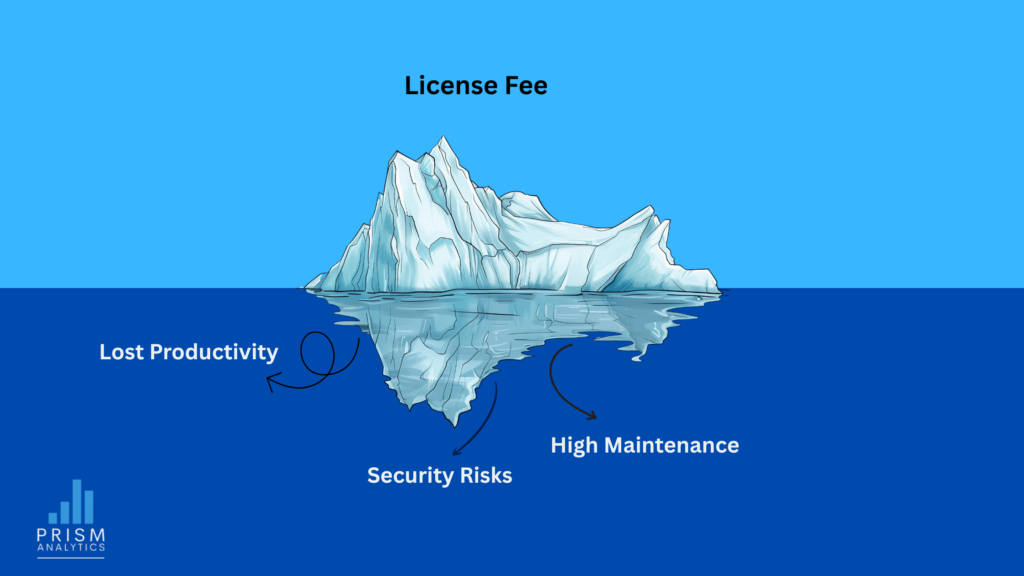
The visible license fee is merely the tip of the iceberg. The real Total Cost of Ownership is submerged in ancillary budgets:
- Infrastructure Overhead: The compute and storage resources dedicated to hosting the legacy tool’s application and data mart layers, often in a separate IaaS environment.
- Specialist Lock-In: The need to retain or hire for niche skills related to the legacy technology, diverting budget from building modern data competencies.
- Integration Debt: The cumulative cost of custom connectors, middleware, and one-off projects to force integration with new cloud services and applications.
When audited holistically, the “stable” cost of the legacy system is frequently eclipsed by the sum of its hidden dependencies. A cloud-native analytics platform consolidates these costs, trading capital expenditure for a scalable operational model and freeing talent to work on value-added tasks.
4. Your Decision Latency is a Competitive Disadvantage
In the current landscape, the speed of insight is a direct competitive differentiator. Legacy BI architectures, often built on batch-oriented, nightly refresh cycles, introduce an inherent and unacceptable delay.
Strategic decisions are being made with stale data. The cost is quantifiable: missed arbitrage opportunities, slower response to logistical disruptions, and an inability to trigger real-time customer interventions.
The architectural capability in question is support for streaming ingestion and low-latency querying. If your BI platform cannot natively consume and visualize real-time data streams, you are fundamentally operating in the past.
5. Your Analytics Platform is a Architectural Dead End
This is the most critical strategic risk. Your BI tool should not be a terminal endpoint for data; it must be an integrated component of a larger Data & AI fabric.
Legacy systems are monolithic by design, architected in an era before cloud-native compute and machine learning were first-class citizens. They cannot serve as the feature store for an ML model, nor can they be easily invoked by an application via API. They are repositories for reports, not participants in an intelligent data workflow.
The modern paradigm is a composable analytics layer. This layer is deeply integrated with the rest of the data stack—seamlessly connecting to data engineering pipelines, providing data to data science workbenches, and embedding insights into operational applications. A legacy tool creates a hard stop in this value chain.
The cost of a dead-end architecture is the inability to innovate. You are not just forgoing efficiency gains; you are building a strategic debt that will be exponentially more expensive to resolve in the future. Evaluating platforms based on their integration capabilities and API-first design is no longer optional; it’s a core responsibility of technical leadership.
Conclusion: The Cost of Architectural Inertia
The symptoms described are not failures of personnel or data quality. They are emergent properties of an architectural mismatch. The legacy BI tool, once a centerpiece of your strategy, has become a bottleneck.
The objective is to evolve from a siloed reporting utility to a integrated analytics capability. This requires a platform that acts as a native citizen within your cloud data ecosystem, enabling governance, empowering users, and providing a foundation for advanced analytics and AI.
The conversation has shifted from tactical cost-saving to strategic capability building. The pivotal question is no longer about the price of change, but about the escalating cost of stagnation.
We help enterprises navigate this architectural transition. Contact our team to schedule a technical architecture review and quantify the operational and strategic debt of your current analytics implementation.